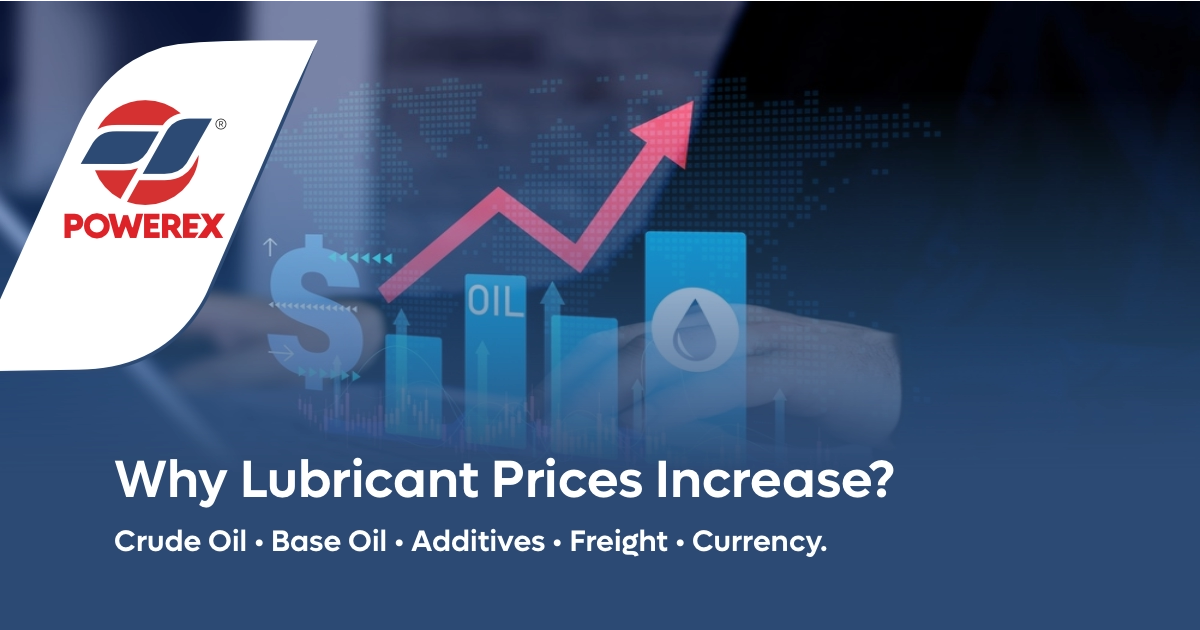
Understand why lubricant prices increase during global tensions and how crude oil, base oil, additives, logistics, currency and supply chain factors affect lubricant cost.
Why Lubricant Prices Increase During Global Tensions
Lubricant prices do not increase only because of one reason. Engine oil, gear oil, hydraulic oil, grease and industrial lubricants are connected with the global petroleum and chemical supply chain. When global tension increases, the cost pressure on lubricants can rise through crude oil, base oil, additives, logistics, packaging and currency movement.
This is why lubricant prices may change even when the product inside the bottle looks the same to the customer. Behind every lubricant, there is a complete chain of raw materials, blending, testing, packaging, transportation and distribution.
1. Crude Oil Price Movement
Crude oil is the starting point of many petroleum-based products. When global tension affects oil-producing regions, shipping routes or market confidence, crude oil prices can become volatile.
Lubricants are not made directly from crude oil in a simple one-step process, but crude oil movement affects the cost of refinery streams, base oils, fuels, transportation and many petrochemical inputs used across the lubricant industry.
2. Base Oil Cost Pressure
Base oil is the main raw material used in most lubricants. Depending on the product type, a lubricant may use Group I, Group II, Group III, synthetic base oil or a combination of different base stocks.
When refinery operations, crude availability or international supply are affected, base oil prices can increase. Since base oil forms a major portion of lubricant formulation cost, even a small increase in base oil price can affect the final lubricant price.
3. Additive Package Cost
A modern lubricant is not only base oil. It also contains additive packages that support performance such as anti-wear protection, detergent action, dispersancy, oxidation control, corrosion protection, viscosity stability and friction control.
Additives are specialty chemicals. Their prices can be affected by global chemical supply, imported raw materials, currency movement, freight cost and production availability. High-performance oils with advanced API, JASO, GL or hydraulic specifications may require stronger additive technology, which adds to formulation cost.
4. Shipping and Logistics Impact
During global tension, shipping routes may become longer, insurance cost may increase and vessel availability may reduce. This can affect import cost for base oils, additives, packaging material and other raw materials.
Higher diesel cost and transport cost also affect domestic movement from port to plant, plant to distributor and distributor to market. Because lubricants are physical products, logistics is an important part of total cost.
5. Currency Exchange Rate
Many lubricant raw materials are linked with international trade. When the rupee weakens against the dollar, imported base oils, additives and chemicals become more expensive.
Even if the international price remains stable, currency movement can increase landed cost in India. This is one reason why local lubricant prices may rise even when customers do not see an immediate change in the local market.
6. Packaging Material Cost
Lubricants require bottles, caps, labels, cartons, drums, buckets and other packaging materials. Many packaging inputs are linked with plastic, paper, metal and printing cost.
When crude oil, polymer, fuel or freight cost increases, packaging cost can also move upward. This affects small packs as well as drums and bulk packaging.
7. Specification and Quality Requirement
Lubricants are becoming technically more advanced. Modern vehicles and machines require oils with better oxidation control, deposit control, wear protection, thermal stability and compatibility with newer engine designs.
Products meeting higher performance levels often require better base oils and advanced additive systems. Therefore, technical quality and specification level also influence lubricant pricing.
8. Why Price Reduction Is Not Always Immediate
When crude oil prices fall, lubricant prices do not always reduce immediately. This is because lubricant manufacturers may already have raw material inventory purchased at higher cost. Additives, packaging, freight and exchange rate may also remain expensive.
There is usually a time gap between crude oil movement and final lubricant market price. Lubricant pricing depends on total formulation cost, not crude oil price alone.
9. How Dealers and Customers Should Understand Price Changes
A price revision in lubricants is generally connected with multiple cost factors. Dealers, workshops and customers should understand that lubricant pricing depends on raw material quality, specification, packaging, supply chain and service support.
Choosing only the cheapest oil may affect product suitability, performance consistency and long-term equipment care. The correct approach is to choose the right lubricant grade and specification from a reliable manufacturer.
Powerex Approach to Lubricant Quality
Powerex Petrochem focuses on technically suitable lubricant formulations for Indian operating conditions. The product range covers motorcycle engine oils, passenger car oils, commercial vehicle oils, gear oils, hydraulic oils, coolants, greases and vehicle care products.
Our focus is to provide dependable product quality, correct grade selection and practical lubricant solutions for dealers, workshops, fleet users, industries and equipment owners.
Final Recommendation
Lubricant price increase during global tension is not only about crude oil. It is a combined effect of base oil cost, additive cost, shipping, currency, packaging, fuel, supply chain and technical specification requirements.
For users, dealers and fleet operators, the best decision is to select lubricants based on correct grade, required specification, genuine quality and reliable supply support.
For lubricant selection, dealership enquiry or bulk supply requirement, contact Powerex Petrochem Private Limited.
Major Factors Behind Lubricant Price Increase
| Cost Factor | How It Affects Lubricant Price |
|---|---|
| Crude Oil | Affects refinery products, petroleum inputs, fuel and base oil market sentiment |
| Base Oil | Main raw material in most lubricants and a major part of formulation cost |
| Additives | Specialty chemicals required for wear protection, cleanliness and performance |
| Logistics | Higher freight, insurance and transport cost increase landed raw material cost |
| Currency | Imported raw materials become costlier when exchange rate moves unfavourably |
| Packaging | Bottles, drums, labels, cartons and caps also move with polymer and freight cost |