Understand the difference between 20W-40 and 10W-30 bike engine oil, where each grade is used, and how to choose the right oil for your motorcycle.
20W-40 vs 10W-30 Bike Engine Oil: Which One Is Right for Your Motorcycle?
Choosing the correct engine oil grade is one of the most important decisions for motorcycle maintenance. Two common grades used in Indian bikes are 20W-40 and 10W-30. Many riders and workshops compare these two grades, but they are not direct replacements for every motorcycle.
The right engine oil depends on the vehicle manufacturer's recommendation, engine design, riding condition, temperature, clutch system and service requirement. Using the wrong oil grade can affect lubrication response, engine smoothness, gear shifting feel and long-term engine performance.
What Does Engine Oil Grade Mean?
Engine oil grades such as 20W-40 and 10W-30 are viscosity grades defined under SAE standards. Viscosity means the thickness or flow behaviour of oil at different temperatures.
In these grades, the number before “W” shows cold-temperature flow behaviour, while the number after “W” shows oil thickness at engine operating temperature.
- 10W flows better than 20W during cold start conditions.
- 30 is lighter at operating temperature compared to 40.
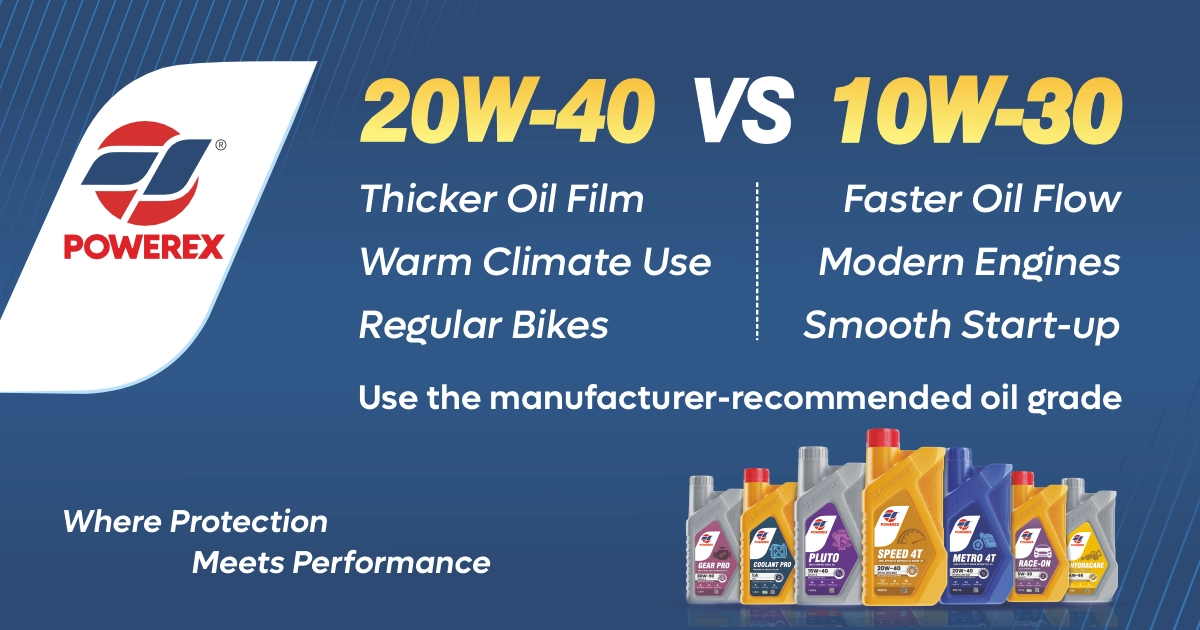
- 40 gives a thicker oil film at operating temperature compared to 30.
What Is 20W-40 Bike Engine Oil?
20W-40 engine oil is a commonly used motorcycle oil grade in India, especially for many commuter bikes and regular-use motorcycles. It offers a balanced oil film at engine operating temperature and is suitable for engines where 20W-40 is recommended by the motorcycle manufacturer.
This grade is often preferred in motorcycles running under regular Indian riding conditions such as city traffic, moderate load, frequent start-stop riding and warm climate operation.
Where Is 20W-40 Usually Used?
- Daily commuter motorcycles where 20W-40 is recommended.
- 4-stroke petrol motorcycles requiring JASO MA or JASO MA2 compatibility.
- Motorcycles operating in warm climate and regular city traffic.
- Older or conventional motorcycle engines designed for slightly thicker oil.
- Riders looking for stable oil film under routine riding conditions.
What Is 10W-30 Bike Engine Oil?
10W-30 engine oil is a lighter viscosity motorcycle oil compared to 20W-40. It provides faster oil circulation during start-up and lower internal resistance in engines designed for this grade.
Many modern motorcycles and scooters are designed with tighter engine clearances and improved lubrication systems. In such cases, 10W-30 oil may be recommended by the vehicle manufacturer for better oil flow and efficient engine operation.
Where Is 10W-30 Usually Used?
- Modern motorcycles where 10W-30 is recommended by the manufacturer.
- Selected scooters and commuter bikes requiring lower viscosity oil.
- Engines designed for faster oil circulation and improved fuel efficiency.
- Motorcycles requiring API SN or API SP performance level oil.
- Daily riding conditions where quick oil flow and smooth engine response are important.
20W-40 vs 10W-30: Main Difference
| Point | 20W-40 Engine Oil | 10W-30 Engine Oil |
|---|---|---|
| Cold Start Flow | Moderate | Better cold flow |
| Operating Temperature Thickness | Thicker oil film | Lighter oil film |
| Common Use | Commuter and regular motorcycles | Modern motorcycles and selected scooters |
| Engine Design Suitability | Engines designed for 20W-40 oil | Engines designed for 10W-30 oil |
| Fuel Efficiency Support | Standard | Usually better in compatible engines |
| Best Selection Method | Use only where 20W-40 is recommended | Use only where 10W-30 is recommended |
Can We Use 20W-40 Instead of 10W-30?
In general, it is not advisable to replace 10W-30 with 20W-40 unless the motorcycle manufacturer allows it. A thicker oil may not flow as quickly in an engine designed for lighter oil. This can affect oil circulation, engine response and fuel efficiency.
Some mechanics use thicker oil to reduce engine noise in older engines, but this should not be treated as a universal solution. The correct approach is to check the owner's manual or service recommendation.
Can We Use 10W-30 Instead of 20W-40?
10W-30 should not be used in motorcycles requiring 20W-40 unless specifically approved by the manufacturer. If the engine is designed for thicker oil, using lighter oil may reduce oil film strength under high temperature, load or continuous riding conditions.
Why JASO MA and JASO MA2 Matter in Bike Engine Oil
Most 4-stroke motorcycles use a wet clutch system, where the engine oil also lubricates the clutch and gearbox. That is why motorcycle oils should meet JASO MA or JASO MA2 requirements where wet clutch compatibility is required.
Car engine oils should not be used in wet clutch motorcycles unless they are specifically suitable for motorcycle wet clutch applications. Wrong oil selection can cause clutch slippage, poor gear feel or inconsistent clutch engagement.
Which Oil Should You Choose?
The best engine oil is not decided only by brand or viscosity. It should match the motorcycle manufacturer's recommended grade and specification.
- Use 20W-40 if your motorcycle manufacturer recommends 20W-40 oil.
- Use 10W-30 if your motorcycle manufacturer recommends 10W-30 oil.
- For wet clutch motorcycles, check for JASO MA / MA2 compatibility.
- For modern bikes, also check the required API level such as API SN or API SP.
- Avoid mixing different grades unless necessary in an emergency.
Final Recommendation
Both 20W-40 and 10W-30 are useful motorcycle engine oil grades, but they are made for different engine requirements. 20W-40 offers a thicker operating oil film, while 10W-30 provides faster flow and lighter viscosity in compatible engines.
Always select engine oil according to the motorcycle manufacturer's recommendation. For workshops, dealers and riders, using the correct grade helps maintain engine lubrication, clutch compatibility and smooth riding performance.
For motorcycle engine oil selection, bulk requirement or dealership enquiry, contact Powerex Petrochem Private Limited.