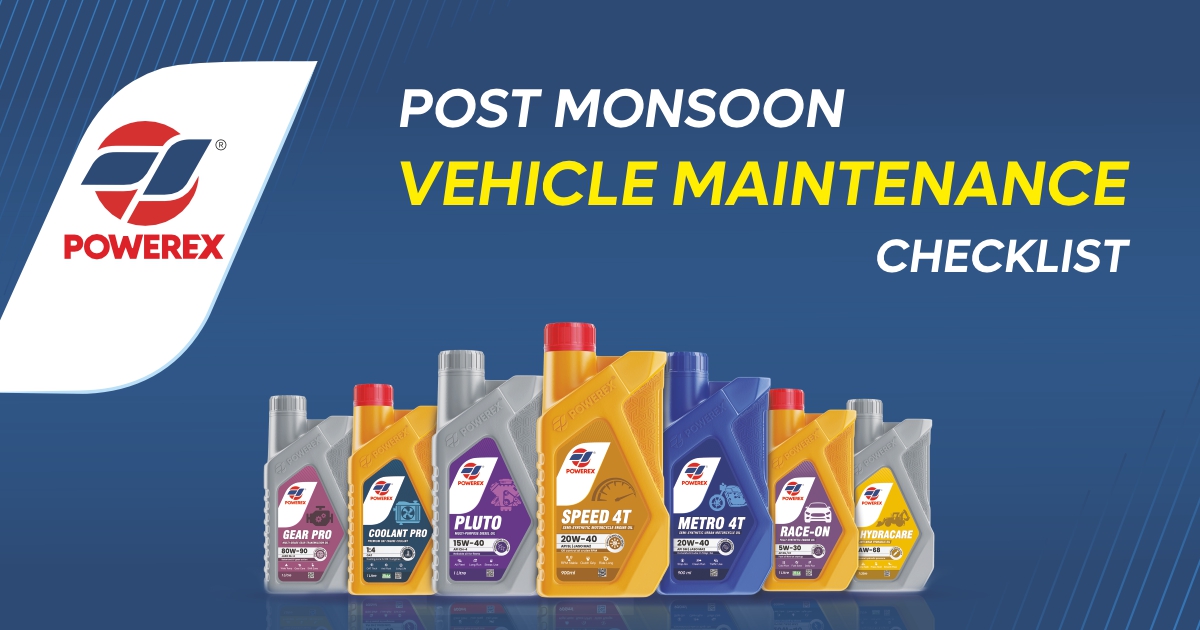
Post-monsoon vehicle maintenance guide covering engine oil, tyres, brakes, coolant, air filters, corrosion and essential fluids to help keep your vehicle protected and performing reliably.
The monsoon season can be demanding on your vehicle. Continuous exposure to rain, moisture, muddy roads, waterlogged areas and changing driving conditions can affect several components — even when there are no obvious signs of trouble.
As the monsoon begins to recede, a simple vehicle inspection can help identify potential issues early and keep your car, motorcycle or commercial vehicle ready for the months ahead.
Here is a practical post-monsoon vehicle maintenance checklist every vehicle owner should consider.
1. Check Your Engine Oil
Engine oil is one of the most important fluids in your vehicle because it helps lubricate moving components and supports engine protection during operation.
After prolonged monsoon use, check:
- Engine oil level
- Whether an oil change is due according to the recommended service interval
- Any unusual appearance or signs of contamination
- Leakage around the engine or oil sump
Oil colour alone should not be used to decide whether an engine oil needs replacement. Always consider the vehicle manufacturer's recommended oil-change interval, operating conditions and lubricant specification.
Most importantly, use the correct viscosity grade and performance specification recommended for your engine.
Choosing engine oil only based on price, brand familiarity or the assumption that “thicker oil is better” can result in selecting a lubricant that may not be appropriate for the application.
2. Inspect for Corrosion
Moisture is one of the most common challenges during the rainy season.
Areas regularly exposed to water and humidity may gradually develop corrosion, particularly when dirt and moisture remain trapped for extended periods.
Inspect areas such as:
- Battery terminals
- Exposed metal components
- Underbody
- Fasteners and brackets
- Electrical connection areas
- Motorcycle chains and exposed mechanical parts
Battery terminals should be kept clean and properly connected. Visible corrosion or unusual deposits should be inspected and addressed before they become more serious.
For motorcycles, proper chain cleaning and lubrication after frequent rain exposure is also an important part of routine maintenance.
3. Check the Air Filter
Your engine requires a proper supply of clean air for normal operation.
During monsoon driving, moisture, dust and road contamination can affect the air-filtering system.
Check the air filter for:
- Excessive dirt
- Moisture exposure
- Blockage
- Physical damage
A heavily contaminated or damaged air filter should be serviced or replaced according to the vehicle manufacturer's recommendations.
This is a simple inspection, but it can be easily overlooked during regular vehicle maintenance.
4. Inspect Your Tyres
Tyres play a particularly important role during wet-road driving.
After months of travelling through rain, rough roads and waterlogged conditions, inspect:
- Tread condition
- Uneven wear
- Cuts or visible damage
- Tyre pressure
- Sidewall condition
Correct tyre pressure should be maintained according to the vehicle manufacturer's recommendation.
If the tread is excessively worn or the tyre shows visible damage, have it inspected by a qualified professional.
5. Check the Braking System
Wet conditions, dirt and frequent stop-and-go driving can put additional attention on the braking system.
Pay attention to symptoms such as:
- Unusual braking noise
- Reduced braking response
- Vibration while braking
- Brake warning indicators
- Unusual pedal feel
Brake pads, discs, drums and related components should be inspected periodically as part of normal vehicle maintenance.
Brake performance is a safety-critical area, so any unusual behaviour should be checked by a qualified technician or workshop.
6. Check Brake Fluid
Brake fluid is another important maintenance item that should not be ignored.
Check:
- Fluid level
- Recommended replacement interval
- Any visible leakage
- Correct brake-fluid specification for the vehicle
Never select brake fluid simply by appearance or price.
Use only the specification recommended for the braking system, such as the appropriate DOT grade, where applicable.
7. Inspect the Coolant
Engine coolant supports temperature management and helps protect the cooling system.
Even after the rainy season, your engine continues to operate under significant thermal conditions.
Check:
- Coolant level
- Any visible leakage
- Condition of hoses and connections
- Radiator and reservoir condition
- Correct coolant type recommended for the vehicle
Do not assume that plain water is always an adequate replacement for properly formulated coolant.
A suitable coolant is designed not only to assist with heat transfer but also to support protection of compatible cooling-system components.
8. Look for Water or Moisture Inside the Vehicle
Monsoon exposure is not limited to the engine compartment.
Inspect areas such as:
- Floor mats
- Carpet
- Boot area
- Door seals
- Spare-wheel compartment
- Cabin filter
Persistent moisture inside the cabin can create unpleasant odours and may indicate water ingress.
Allow wet areas to dry properly and investigate the source if moisture repeatedly enters the cabin.
9. Inspect Electrical Components
Modern vehicles depend heavily on electrical and electronic systems.
After extensive exposure to rain, check:
- Headlights
- Indicators
- Brake lights
- Horn
- Wipers
- Power windows
- Dashboard warning lights
Any irregular electrical behaviour should be inspected rather than ignored.
10. Don't Forget the Wipers
Wiper blades work continuously during the rainy season and can wear gradually.
Check whether the blades:
- Leave streaks
- Make unusual noise
- Skip across the windscreen
- Fail to clear water properly
Also inspect the windscreen washer-fluid level.
Good visibility is essential regardless of the season.
The Right Lubricant Matters in Every Season
Seasonal maintenance is not only about replacing components.
It is also about ensuring that the correct lubricant and automotive fluid is being used for the correct application.
When selecting engine oil, gear oil, coolant, brake fluid or other automotive fluids, consider:
- Vehicle manufacturer recommendation
- SAE viscosity grade
- Required performance specification
- Application
- Operating conditions
- Product quality and consistency
A lubricant should not be selected only because it is inexpensive, widely known or has a familiar viscosity number.
The correct product is the one that meets the requirements of the intended application.
Make Post-Monsoon Inspection a Routine
A post-monsoon vehicle check does not need to be complicated.
Start with the fundamentals:
Engine Oil → Corrosion → Air Filter → Tyres → Brakes → Coolant → Brake Fluid → Electricals
Small inspections carried out at the right time can help identify maintenance requirements before they become larger problems.
If you are unsure about any component, fluid or lubricant requirement, consult your vehicle manual or a qualified mechanic.
Powerex Lubricants — Where Protection Meets Performance
Powerex Petrochem Pvt. Ltd. manufactures a comprehensive range of automotive and industrial lubrication products designed for multiple vehicle, machinery and equipment applications.
Our portfolio includes engine oils, gear oils, greases, coolants, brake fluids and other automotive lubrication and maintenance products.
Choose the right lubricant for the right application.
Powerex — Where Protection Meets Performance.